 +91 9618519486

 Yashoda Hospital,
Hitec City
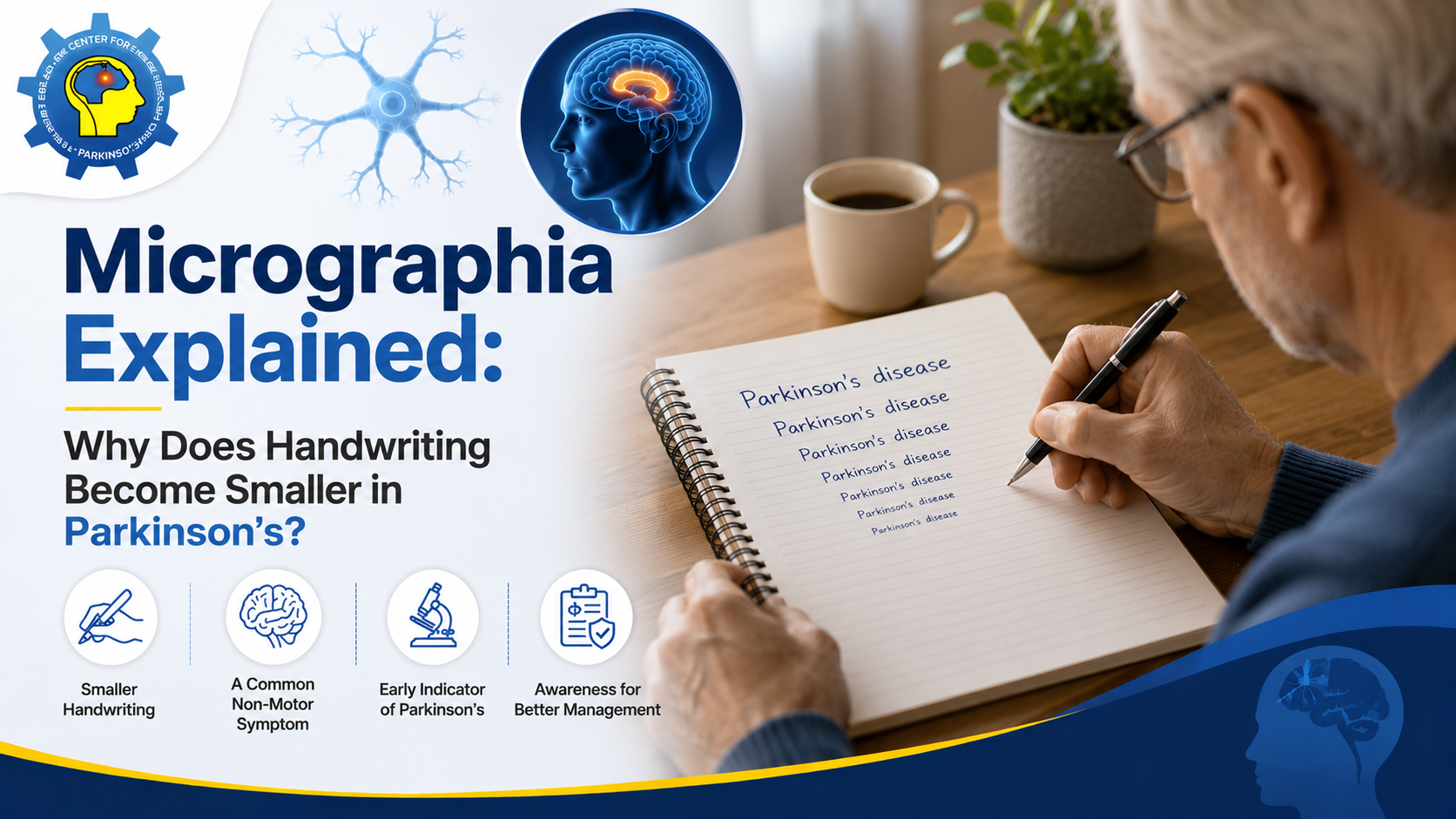
Handwriting is one of those everyday skills that rarely gets a second thought—until it starts to change. For some people, that change shows up as letters that shrink as they write across the page, words that crowd together, or a signature that no longer looks like their own. This condition is known as micrographia, and it's one of the more distinctive early handwriting changes linked to Parkinson's disease.
Because handwriting feels like such a minor, everyday task, micrographia is often dismissed as fatigue, poor posture, or "just getting older." In reality, it can be one of the earlier physical clues that something neurological is going on. This guide breaks down what micrographia actually is, why it happens, and what it means for a possible Parkinson's diagnosis.
What Is Micrographia?
Micrographia is a condition where handwriting becomes abnormally small, and it often keeps getting smaller as a person continues writing on the same line or page. It's different from someone simply having naturally small handwriting. With micrographia, there's usually a noticeable shift from a person's normal handwriting size to something visibly smaller, cramped, and harder to read.
Two general patterns are commonly described:
- Consistent micrographia, where letters stay uniformly small throughout a writing sample.
- Progressive micrographia, where letters start at a fairly normal size and shrink progressively the longer the person writes, sometimes trailing off into a tight scrawl by the end of a sentence.
The second pattern, progressive micrographia, is particularly associated with Parkinson's disease.
Why Does Parkinson's Cause Small Handwriting?
Handwriting is a surprisingly complex motor task. It requires the brain to coordinate small, precise finger and wrist movements, sustain consistent pressure, and continuously adjust muscle output as the pen moves across the page. Parkinson's disease disrupts this process at a fundamental level.
The condition develops as dopamine-producing neurons in the brain gradually decline. Dopamine plays a central role in regulating movement, particularly the smooth, automatic execution of repetitive motor tasks like writing, walking, or buttoning a shirt. When dopamine levels drop, movements tend to become smaller and slower, a symptom known broadly as bradykinesia.
Micrographia is essentially bradykinesia showing up in the small muscles of the hand. As writing continues, the brain struggles to maintain the amplitude of each stroke, so letters that start out close to normal size gradually contract. This is why the progressive shrinking pattern, rather than uniformly small handwriting, tends to raise more suspicion for Parkinson's.
Is Micrographia Always a Sign of Parkinson's?
Not necessarily. Small or shrinking handwriting can occur for reasons unrelated to Parkinson's, including:
- Arthritis or joint stiffness in the hand or wrist
- Essential tremor or other movement disorders
- Nerve conditions affecting the hand
- Certain medications
- Normal fatigue during long writing tasks
What tends to distinguish Parkinson's-related micrographia is the pattern and company it keeps. A gradual, progressive shrinking of letters within the same writing sample, especially when paired with other early Parkinson's symptoms, is more clinically significant than occasional small handwriting on its own.
Other Symptoms That Often Appear Alongside Micrographia
Micrographia rarely shows up in isolation when it's related to Parkinson's disease. It's often one of several early motor and non-motor changes, including:
- A slight tremor in the hand or fingers, especially at rest
- Muscle stiffness or rigidity
- Slower movements overall (bradykinesia)
- A softer, more monotone voice
- Reduced facial expression
For a fuller picture of these related changes, see our guide on the early signs of Parkinson's disease.
How Micrographia Fits Into a Parkinson's Diagnosis
There's no single test that diagnoses Parkinson's disease. Instead, neurologists build a clinical picture using a combination of symptom history, physical examination, and sometimes imaging or response to medication. Handwriting samples can be a genuinely useful, low-cost tool in this process.
Some neurologists ask patients to write a standard sentence or phrase during an evaluation, sometimes repeating it several times, to observe whether letters shrink progressively. This isn't the deciding factor in a Parkinson's diagnosis, but it can support other clinical findings, particularly bradykinesia, tremor, and rigidity, which are considered the core motor features of the condition.
Because handwriting changes can appear early, sometimes before a formal diagnosis, keeping old samples of handwriting, like signed cards or notes, can occasionally help a doctor see how writing has changed over time.
Can Micrographia Be Treated?
Micrographia often improves to some degree with treatments that address the underlying Parkinson's disease, since it's a downstream effect of reduced dopamine activity rather than a separate condition. Common approaches include:
- Medication. Dopaminergic medications, commonly used to manage Parkinson's motor symptoms, can sometimes improve handwriting size and control.
- Occupational therapy. Therapists can teach specific writing techniques, such as using wider-ruled paper, thicker pens, or visual cues, to help maintain more consistent letter size.
- Deep brain stimulation (DBS). For patients with more advanced motor symptoms who qualify for it, DBS surgery has been shown to improve several motor symptoms of Parkinson's, and some patients report improvements in handwriting as part of broader motor symptom control. You can learn more about how the procedure works in our guide to DBS surgery.
Results vary from person to person, and not every treatment approach will meaningfully change handwriting size. A neurologist can help determine which options make sense based on the overall symptom picture.
When to See a Neurologist
Occasional small handwriting, especially when you're tired, rushing, or writing in an awkward position, usually isn't cause for concern. It's worth having handwriting changes evaluated by a neurologist if you notice:
- Letters that progressively shrink within the same writing sample
- Handwriting changes that have developed gradually over months
- Accompanying symptoms like tremor, stiffness, or a softer voice
- A family member or friend pointing out that your handwriting looks different than it used to
Frequently Asked Questions
What does micrographia handwriting look like?
Letters are noticeably smaller than a person's usual handwriting, often cramped together, and may progressively shrink as they continue writing across a line or page.
Is micrographia an early or late symptom of Parkinson's?
It can appear early in the disease course, sometimes before a formal diagnosis, though it can also become more pronounced as the condition progresses.
Can stress or anxiety cause small handwriting?
Yes, tension and rushed writing can produce smaller handwriting temporarily, but this typically doesn't follow the same progressive shrinking pattern seen in Parkinson's-related micrographia.
Does treating Parkinson's improve handwriting?
For some people, dopaminergic medication or therapies like DBS surgery can lead to noticeable improvement, though results vary widely between individuals.
Should I be worried if my handwriting has gotten smaller?
Not necessarily, but it's worth mentioning to a doctor if the change is gradual, ongoing, and paired with other symptoms like tremor or stiffness.
Final Thoughts
Micrographia is easy to brush off as a small, unremarkable change, but it can be one of the more telling early handwriting changes tied to Parkinson's disease. On its own, it isn't a diagnosis. Alongside other symptoms, it's a pattern worth having a neurologist take a closer look at.
Noticed your handwriting getting smaller or harder to control? Book an appointment with our specialists today, or contact us to discuss your symptoms.
This article is intended for informational purposes only and does not constitute medical advice. Please consult a qualified healthcare professional for diagnosis and treatment.
Book an appointment --->https://parkinsonsanddbs.com/contact Parkinson's disease --->https://parkinsonsanddbs.com/parkinsons-disease add those hyperlinks in the content Here is the HTML code with the two hyperlinks added to the specified text in the content. html
Micrographia Explained: Why Does Handwriting Become Smaller in Parkinson's?
Handwriting is one of those everyday skills that rarely gets a second thought—until it starts to change. For some people, that change shows up as letters that shrink as they write across the page, words that crowd together, or a signature that no longer looks like their own. This condition is known as micrographia, and it's one of the more distinctive early handwriting changes linked to Parkinson's disease.
Because handwriting feels like such a minor, everyday task, micrographia is often dismissed as fatigue, poor posture, or "just getting older." In reality, it can be one of the earlier physical clues that something neurological is going on. This guide breaks down what micrographia actually is, why it happens, and what it means for a possible Parkinson's diagnosis.
What Is Micrographia?
Micrographia is a condition where handwriting becomes abnormally small, and it often keeps getting smaller as a person continues writing on the same line or page. It's different from someone simply having naturally small handwriting. With micrographia, there's usually a noticeable shift from a person's normal handwriting size to something visibly smaller, cramped, and harder to read.
Two general patterns are commonly described:
- Consistent micrographia, where letters stay uniformly small throughout a writing sample.
- Progressive micrographia, where letters start at a fairly normal size and shrink progressively the longer the person writes, sometimes trailing off into a tight scrawl by the end of a sentence.
The second pattern, progressive micrographia, is particularly associated with Parkinson's disease.
Why Does Parkinson's Cause Small Handwriting?
Handwriting is a surprisingly complex motor task. It requires the brain to coordinate small, precise finger and wrist movements, sustain consistent pressure, and continuously adjust muscle output as the pen moves across the page. Parkinson's disease disrupts this process at a fundamental level.
The condition develops as dopamine-producing neurons in the brain gradually decline. Dopamine plays a central role in regulating movement, particularly the smooth, automatic execution of repetitive motor tasks like writing, walking, or buttoning a shirt. When dopamine levels drop, movements tend to become smaller and slower, a symptom known broadly as bradykinesia.
Micrographia is essentially bradykinesia showing up in the small muscles of the hand. As writing continues, the brain struggles to maintain the amplitude of each stroke, so letters that start out close to normal size gradually contract. This is why the progressive shrinking pattern, rather than uniformly small handwriting, tends to raise more suspicion for Parkinson's.
Is Micrographia Always a Sign of Parkinson's?
Not necessarily. Small or shrinking handwriting can occur for reasons unrelated to Parkinson's, including:
- Arthritis or joint stiffness in the hand or wrist
- Essential tremor or other movement disorders
- Nerve conditions affecting the hand
- Certain medications
- Normal fatigue during long writing tasks
What tends to distinguish Parkinson's-related micrographia is the pattern and company it keeps. A gradual, progressive shrinking of letters within the same writing sample, especially when paired with other early Parkinson's symptoms, is more clinically significant than occasional small handwriting on its own.
Other Symptoms That Often Appear Alongside Micrographia
Micrographia rarely shows up in isolation when it's related to Parkinson's disease. It's often one of several early motor and non-motor changes, including:
- A slight tremor in the hand or fingers, especially at rest
- Muscle stiffness or rigidity
- Slower movements overall (bradykinesia)
- A softer, more monotone voice
- Reduced facial expression
For a fuller picture of these related changes, see our guide on the early signs of Parkinson's disease.
How Micrographia Fits Into a Parkinson's Diagnosis
There's no single test that diagnoses Parkinson's disease. Instead, neurologists build a clinical picture using a combination of symptom history, physical examination, and sometimes imaging or response to medication. Handwriting samples can be a genuinely useful, low-cost tool in this process.
Some neurologists ask patients to write a standard sentence or phrase during an evaluation, sometimes repeating it several times, to observe whether letters shrink progressively. This isn't the deciding factor in a Parkinson's diagnosis, but it can support other clinical findings, particularly bradykinesia, tremor, and rigidity, which are considered the core motor features of the condition.
Because handwriting changes can appear early, sometimes before a formal diagnosis, keeping old samples of handwriting, like signed cards or notes, can occasionally help a doctor see how writing has changed over time.
Can Micrographia Be Treated?
Micrographia often improves to some degree with treatments that address the underlying Parkinson's disease, since it's a downstream effect of reduced dopamine activity rather than a separate condition. Common approaches include:
- Medication. Dopaminergic medications, commonly used to manage Parkinson's motor symptoms, can sometimes improve handwriting size and control.
- Occupational therapy. Therapists can teach specific writing techniques, such as using wider-ruled paper, thicker pens, or visual cues, to help maintain more consistent letter size.
- Deep brain stimulation (DBS). For patients with more advanced motor symptoms who qualify for it, DBS surgery has been shown to improve several motor symptoms of Parkinson's, and some patients report improvements in handwriting as part of broader motor symptom control. You can learn more about how the procedure works in our guide to DBS surgery.
Results vary from person to person, and not every treatment approach will meaningfully change handwriting size. A neurologist can help determine which options make sense based on the overall symptom picture.
When to See a Neurologist
Occasional small handwriting, especially when you're tired, rushing, or writing in an awkward position, usually isn't cause for concern. It's worth having handwriting changes evaluated by a neurologist if you notice:
- Letters that progressively shrink within the same writing sample
- Handwriting changes that have developed gradually over months
- Accompanying symptoms like tremor, stiffness, or a softer voice
- A family member or friend pointing out that your handwriting looks different than it used to
Frequently Asked Questions
What does micrographia handwriting look like?
Letters are noticeably smaller than a person's usual handwriting, often cramped together, and may progressively shrink as they continue writing across a line or page.
Is micrographia an early or late symptom of Parkinson's?
It can appear early in the disease course, sometimes before a formal diagnosis, though it can also become more pronounced as the condition progresses.
Can stress or anxiety cause small handwriting?
Yes, tension and rushed writing can produce smaller handwriting temporarily, but this typically doesn't follow the same progressive shrinking pattern seen in Parkinson's-related micrographia.
Does treating Parkinson's improve handwriting?
For some people, dopaminergic medication or therapies like DBS surgery can lead to noticeable improvement, though results vary widely between individuals.
Should I be worried if my handwriting has gotten smaller?
Not necessarily, but it's worth mentioning to a doctor if the change is gradual, ongoing, and paired with other symptoms like tremor or stiffness.
Final Thoughts
Micrographia is easy to brush off as a small, unremarkable change, but it can be one of the more telling early handwriting changes tied to Parkinson's disease. On its own, it isn't a diagnosis. Alongside other symptoms, it's a pattern worth having a neurologist take a closer look at.
Noticed your handwriting getting smaller or harder to control? Book an appointment with our specialists today, or contact us to discuss your symptoms.
This article is intended for informational purposes only and does not constitute medical advice. Please consult a qualified healthcare professional for diagnosis and treatment.